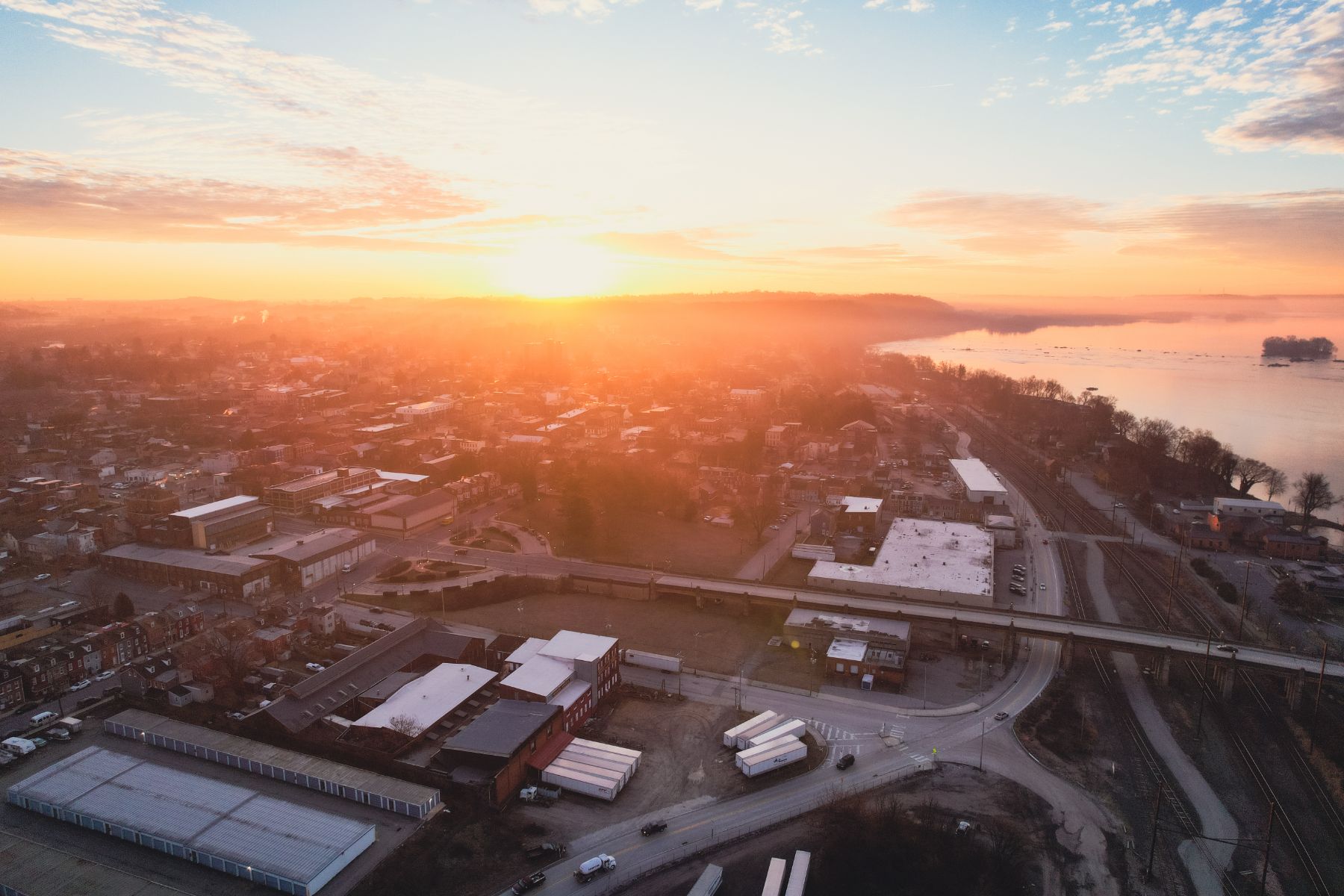
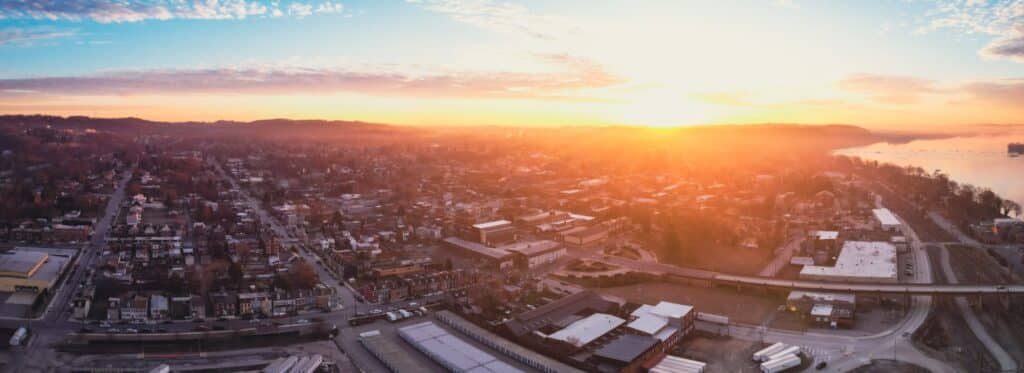
Walk Front Street in genteel Marietta today, and you will soak in the river’s peace and the quaint Victorian structures.
But back in the day, Marietta was known as a “rowdy river town”. If you walked Front Street in the mid-nineteenth century, you would be stepping into a beehive of activity. Taverns, wharves, and warehouses lined the streets. And of course, a red-light district.
Horses and wagons jostle by. Mules trudge the canal towpath, pulling boats as the boatmen call to each other, loading and unloading cargo or blowing their conch shells to announce their arrival. Clanging comes from nearby iron works, and smoke from their operation hangs thick in the air. Long timber rafts float down the Susquehanna from Williamsport and berth here. Our time-traveler can see them being broken apart to be taken to the various sawmills that processed them into lumber. Now a train rumbles through, on its way to pick up a load of pig iron.
Front Streets in Columbia and Wrightsville would also have been a hive of river activity. All three towns fed off each other’s energy.
After the massive logging operations ramped up in Williamsport in the 1840s, whole forests of Northern Pennsylvania floated down the river. Marietta became a major stop, and numerous sawmills sprang up to handle the huge amounts of timber that flowed through.
Why Marietta? The story of the three River Towns is intimately bound together. A mid-nineteenth-century map shows the picture: Columbia is a compact square, while Marietta has the space to stretch far across the river. It’s the river access. At the time, the population of Marietta was fully half that of Columbia. Columbia and Wrightsville provided connections to important markets east and west.
At this time, the three River Towns should be thought of as a single interconnected network of industry and transportation. One of the first railroads in the nation stretched from Philadelphia through Lancaster to Columbia in 1834, the same year the second bridge (the longest covered bridge in the world) tied Wrightsville more tightly into the system.
The Pennsylvania Main Line Canal came down from Middletown/Harrisburg to Marietta. Mules pulled the boats across using a towpath built across the bridge to Wrightsville. Then they continued down the Susquehanna and Tidewater Canal to Havre de Grace.
It sounds clunky to us, but it represented a great leap forward in the day.
Columbia was the dominant transportation, finished goods, and warehousing hub; Marietta developed a particularly strong riverfront industrial economy which seamlessly blended into Columbia; and Wrightsville connected the system westward toward York and southward through the Tidewater Canal to the Chesapeake. In its day, the three River Towns were literally integrated into one of the earliest, most developed inland industrial distribution nodes in the country.
Lumber helped transform Marietta into a thriving inland port. Then came the blast furnaces.
Today’s walking trail between Marietta and Columbia became one of Pennsylvania’s premier industrial corridors, filled with no less than eight blast furnaces churning out pig iron. Lancaster County had been iron country since colonial times, but an extraordinary concentration of anthracite furnaces now developed along this stretch of the Susquehanna, meaning the industrial footprint along the river stretched for several miles.
Pennsylvania would become the nation’s leading iron-producing state, and the Columbia-Marietta corridor became important enough to acquire an evocative nickname: “Little Pittsburgh.” Even Marietta had several lumber and blast furnace millionaires back in the day.
Columbia had its own furnace and increasingly moved beyond pig iron into rolling mills, foundries, and machine shops. Across the river, Wrightsville developed industries such as limestone production, quarrying, and tobacco processing, eventually adding the large Aurora Furnace in 1867.
But none of this explains yet quite why such an extraordinary concentration of industry developed here in the first place.
We begin with William Penn’s “Holy Experiment” in Quaker values of toleration and diversity, which proved remarkably successful. Pennsylvania’s reputation for religious tolerance and economic opportunity for a wide diversity of groups helped produce extraordinary immigration and economic activity. Germans, Scots-Irish, Mennonites, Amish, and other groups poured through Philadelphia–and many moved west through the Pennsylvania interior.
The development of the Conestoga Wagon in Lancaster County was the vehicle that helped make that interior settlement possible. The principal interior road in the colonies in the latter half of the 18th century was the Great Wagon Road, which went through this corridor to open back-country settlement to western Pa., and then south to Virginia, the Carolinas, and Kentucky.
One of the great migrations of the continent passed through Philadelphia–and Lancaster and Columbia-Wrightsville became some of the principal gateways in all the colonies to the American frontier. By the eve of the Revolution, Philadelphia was the largest and most powerful city in British North America, feeding the dynamic corridor through the River Towns.
Then in 1825 the Erie Canal gave New York access to western Pa. and the Ohio country, “the Old West” (today’s Midwest). This older frontier promised to reshape the economic fortunes of anyone who could tap into it. Then the “Baltimore and Ohio” railroad reached Harper’s Ferry in 1834.
Philadelphia merchants realized they might be squeezed out of Old West development. They could lose their dominant position. So they launched the “Main Line” public works, which linked Pittsburgh to Philadelphia through an innovative system of canals and inclined planes–and the River Towns were a linchpin in this network.
The final leg was the Philadelphia and Columbia Railroad, the state’s first great long-distance railroad.
At 82 miles, it was pushing the limits of the technology that had only been invented the decade before. In comparison, the Baltimore & Ohio, at 137 miles to Harper’s Ferry, was the longest single-tracked railroad in the world at the time. However, the Philadelphia and Columbia Railroad could lay claim to being the longest double-tracked railroad in the world at the time.
The River Towns were–briefly–at the leading edge of the industrialization of transportation.
The technology was so new that they kept having derailments, so they had to make repeated adjustments to the track design. When it first began operating in the city of Philadelphia, it was actually pulled by horses. This line to Columbia became the proving ground for an entire generation of engineers and mechanics, paving the way for the rise of the Pennsylvania Railroad, which became the largest corporation in the world.
For a brief period, the River Towns sat at the western end of one of the most technologically ambitious railroad lines on Earth. Pennsylvanian anthracite flowed in to fuel the furnaces; iron ore came from local places such as Grubbs, and pig iron flowed to rolling mills that supplied the rail lines that began to crisscross the state and then the Midwest. Roundhouses stored trains and provided repairs in Columbia.
By 1840, the railroad extended into York. Since there was no railroad bridge until 1867, they simply unhooked the cars, pulled them across the bridge with mules, then hooked them up to a new engine in Wrightsville that puffed its way to York and beyond.
But regional fortunes can change.
The Pennsylvania Railroad entered the picture in the 1850s. Its route went from Philadelphia to Harrisburg–which was less mountainous to travel to Pittsburgh–capturing the lion’s share of freight traffic in the state. But even that only slowed the growth, as warehouses and heavy industry, such as rolling mills in Columbia and other enterprises that sprang up to take advantage of the distribution network.
The picture changed further when furnaces in Pittsburgh and Bethlehem began expanding, using the Bessemer process as demand for steel, instead of the more brittle cast iron, overtook the market. Local supplies of iron ore began to peter out. By the last decade of the 19th century, the furnaces that had been running 24 hours a day and seven days a week were shutting down. The Musselman-Vesta furnace in Marietta continued into the 1930s after it converted to producing ferromanganese. A nice little museum commemorating the furnace and Marietta’s industrial past remains on site.
The River Towns began a slow process of economic decline in the 20th century as other industries began to shut down, and trains eventually began to pass through Columbia instead of stopping at it. But for the next generation, the warehouses were still put to use–particularly when Al Capone chose Columbia as a distribution site for his bootleg liquor operation during Prohibition in the 1920s.
Today, the River Towns are on the rise. Money and investment are flowing to the region. Businesses are finding the River Towns attractive. The many Victorian-era buildings that grace the landscape are well kept.
Walk any of the River Towns today, and the ruckus of the canals, the furnaces, the sawmills, the floating forests has disappeared. The forces that made these areas noisy and dirty and dangerous have disappeared and been replaced with peace and beauty. It’s a nice place to be.
The great irony of the River Towns is that for nearly two centuries, their fortunes rose because this was a place where America had to stop—to cross the river, transfer freight, change transportation systems, process raw materials, and send them onward.
Eventually America learned how to pass straight through.
Today, as the River Towns reinvent themselves around history, recreation, tourism, and the Susquehanna itself, they are asking people to do something they haven’t had to do for a while:
Stop again.